A jeweller’s website where visitors design their own ring
A website for a fine jeweller in Geneva, made as a concept build for a client. Visitors design a ring, see a price guide as they go and book a private viewing, in any of seven languages.
- Live
- Website
- Seven languages
- Concept build for client
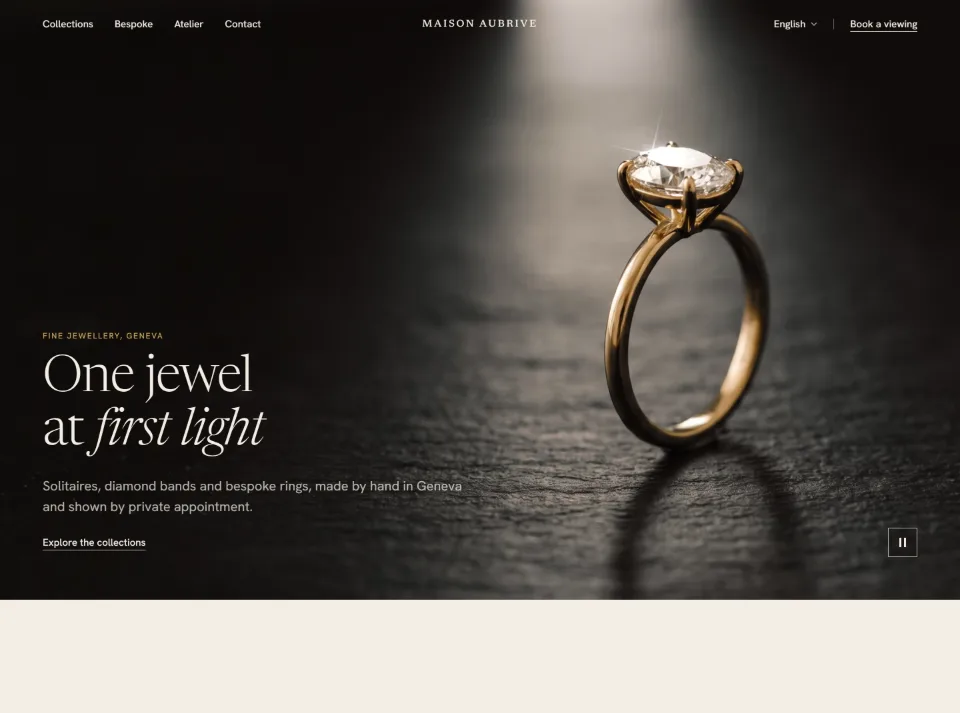
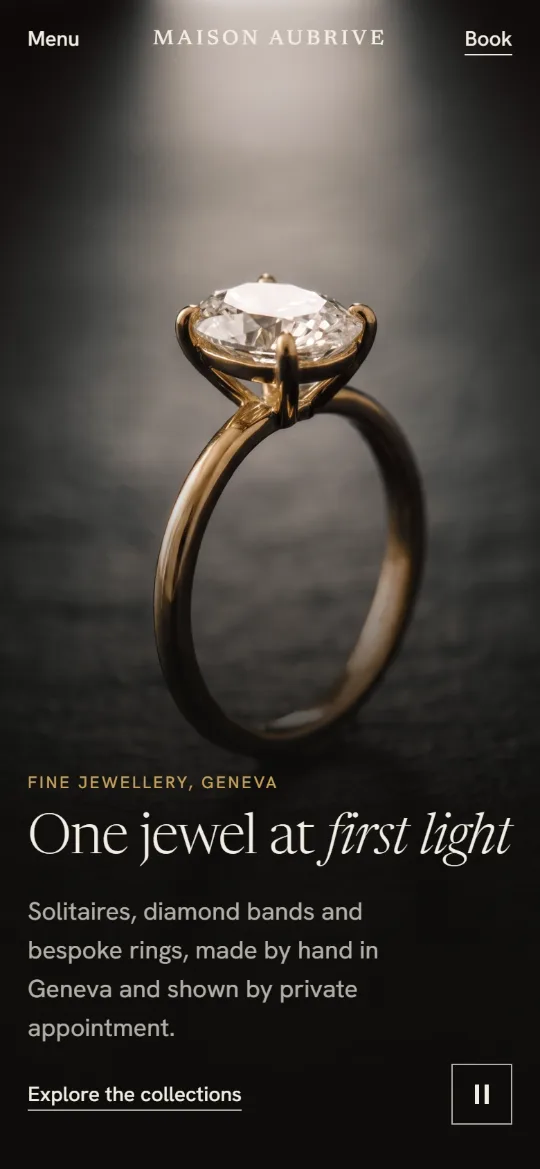
Home page · laptop and phone
- languages, from English and French to Chinese, Japanese and Korean
- 7
- out of 100 for speed, accessibility and good practice, on Google’s Lighthouse test on a phone
- 100
- automated tests passed, 0 failed, including the whole journey from designing a ring to the confirmation
- 35
- weeks to build a site like this
- 5–6
The challenge
Nobody buys an engagement ring from a web page. They buy it in a quiet room, with the stone in front of them. So a fine jeweller’s website has one job: to turn someone browsing into a booked private viewing.
A site with only photographs and a contact form makes that hard. The visitor has to email, wait for a reply, then explain from scratch what they want. And a Geneva boutique serves visitors who read French, German, Chinese, Japanese or Korean before English.
What I built
I designed and built a website concept for a Geneva fine jeweller, under the name Maison Aubrive.
Every page a jeweller needs
A home page that opens on a slow, looping film of light glinting on a diamond ring; three collections, with nine pieces and “From” prices; a bespoke page explaining how a commission runs; the workshop’s story; and contact details, directions and an enquiry form.
A ring designer that ends in a booked viewing
Visitors design a ring, see a price guide as they go, then book a viewing in the boutique or by video call.
Seven languages
English, French, German, Spanish, Chinese, Japanese and Korean. A visitor can switch language on any page and stay exactly where they were, even halfway through designing a ring. Prices and dates are written each language’s own way: CHF 18’400 in English, CHF 18 400 in French.
Phones and desktops
It works on both. Each photograph comes in several sizes, so a phone downloads a phone-sized picture.
How it works for visitors
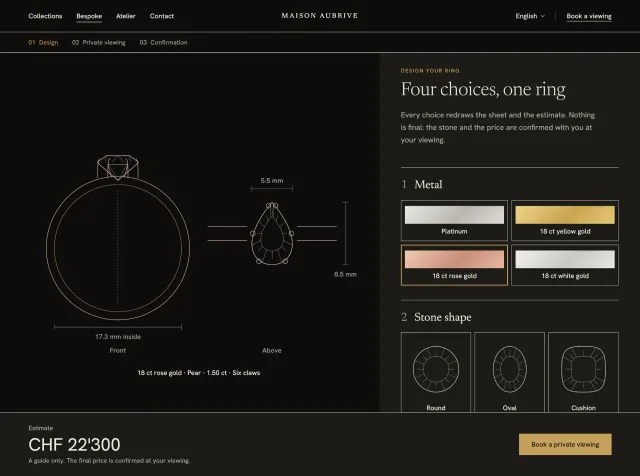
A ring in four choices
Visitors choose a metal (platinum, or 18 ct yellow, rose or white gold), one of six stone shapes, a weight from 0.30 to 3.00 carats, and a setting: four claws, six claws, halo or collar. A jeweller’s drawing of the ring redraws with every choice, with the stone’s size in millimetres, and a price guide at the foot of the screen updates with it.
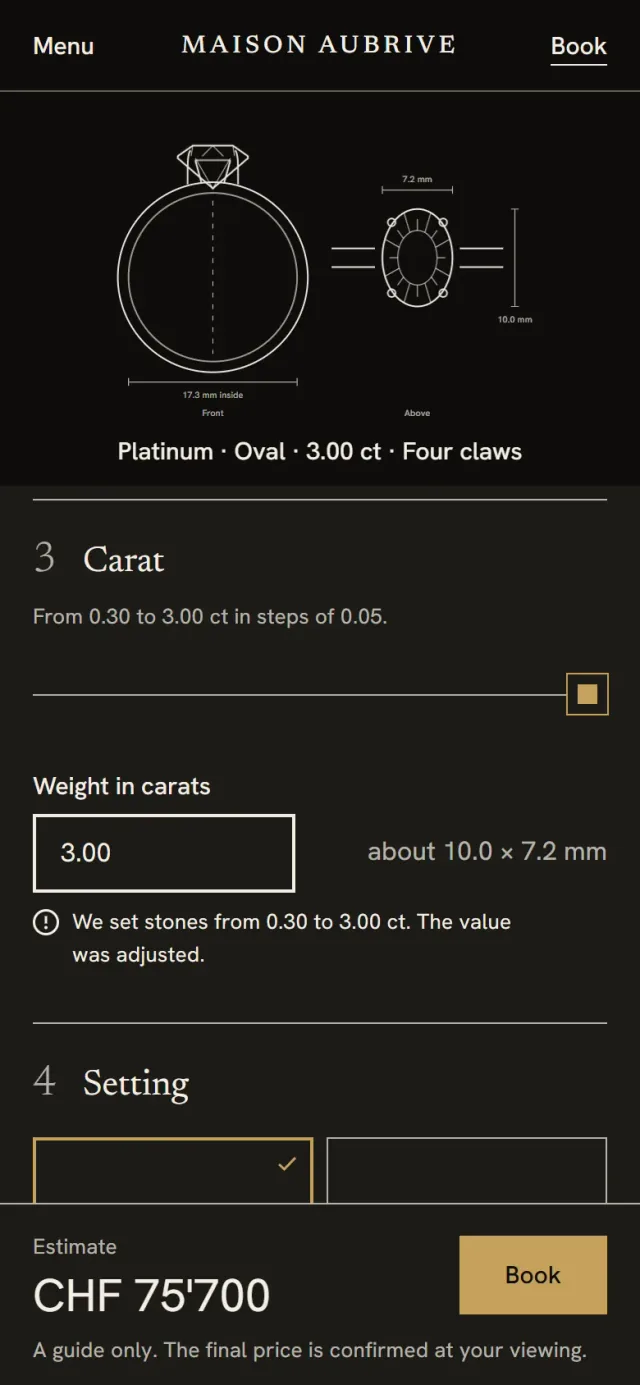
A weight it can’t set, explained
The weight can be set with a slider or typed in. Type one the workshop can’t set, and it’s moved to the nearest one it can, with a sentence saying why. The design is saved as the visitor goes, so someone who comes back days later finds their ring as they left it.
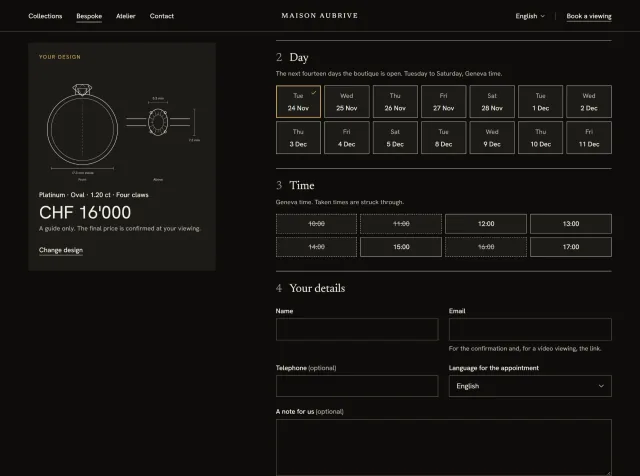
Book a private viewing
Next, the visitor chooses the boutique or a video call, then a day and an hourly time. Taken times are struck through and can’t be chosen. Then a name, an email and the language for the appointment. Mistakes are explained in plain sentences.
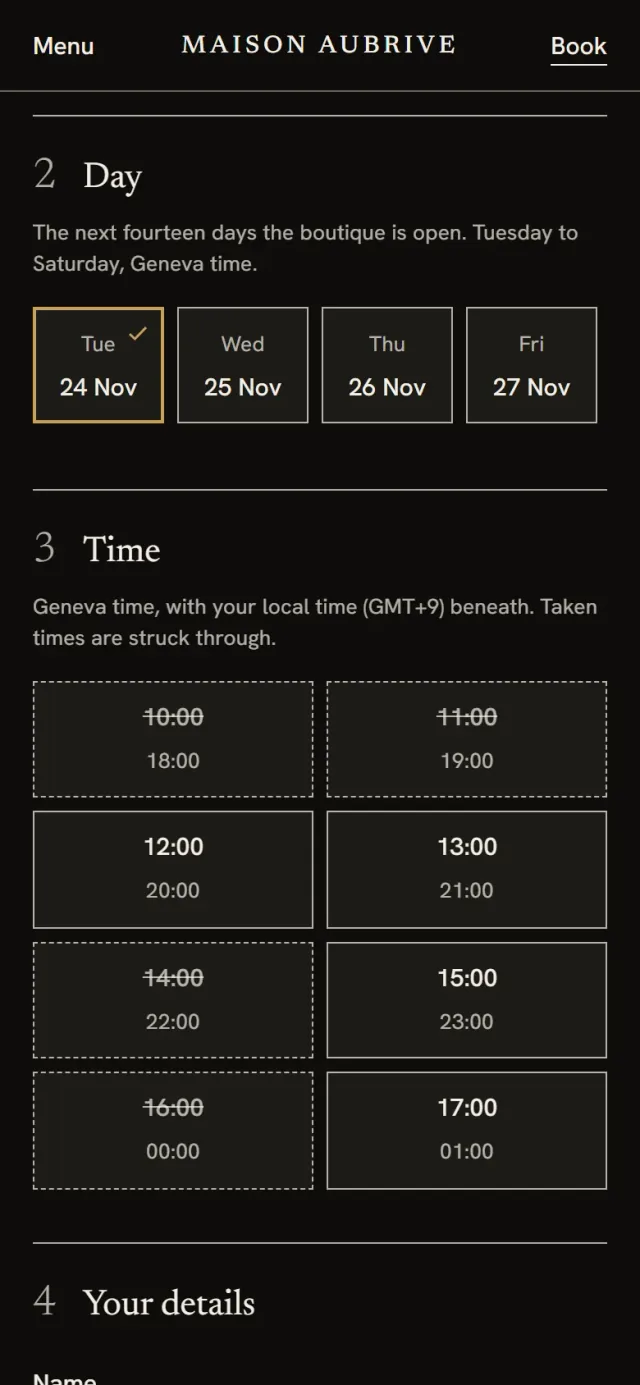
Geneva time, and the visitor’s own
The boutique is in Geneva, but a video call can be booked from anywhere. Each time shows in Geneva time, with the visitor’s own time underneath. The site works out Geneva’s time for each day rather than assuming it, so the times stay right when the clocks change.
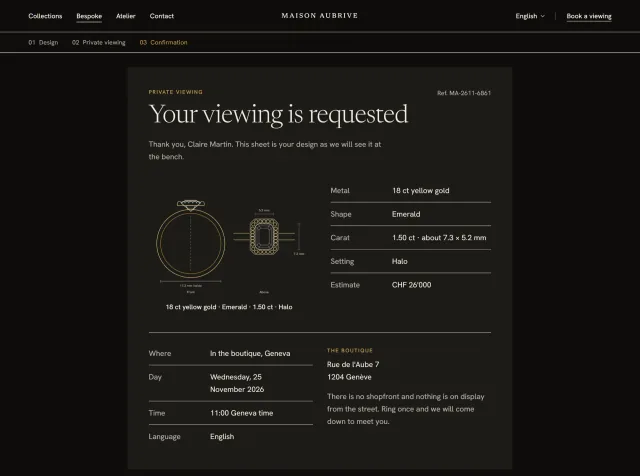
A sheet to bring to the viewing
The visitor receives a confirmation sheet with a reference number, the drawing, the full design and the appointment, plus a file to add it to their calendar. In this concept nothing is sent: bookings stay in the visitor’s own browser, and the site says so. A live version would connect to the boutique’s diary and email.
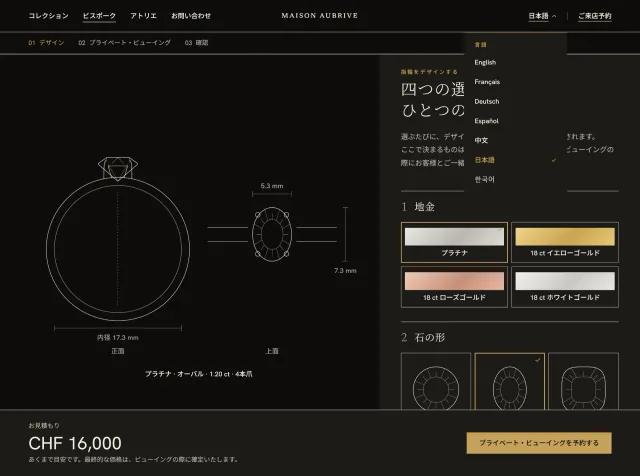
Seven languages, on every page
The language menu is on every page. A visitor who switches stays exactly where they were, even halfway through designing a ring, and prices and dates follow, written the way that language writes them.
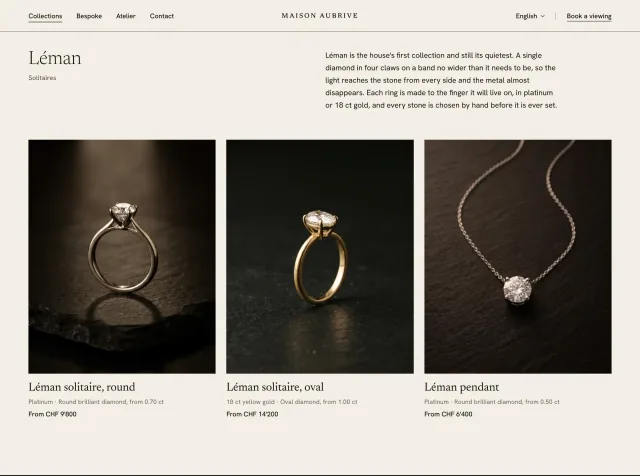
Three collections, nine pieces
Each collection has its own short story and three pieces. Every piece gives its metal, its stones and a “From” price, so visitors know the range before they ask.
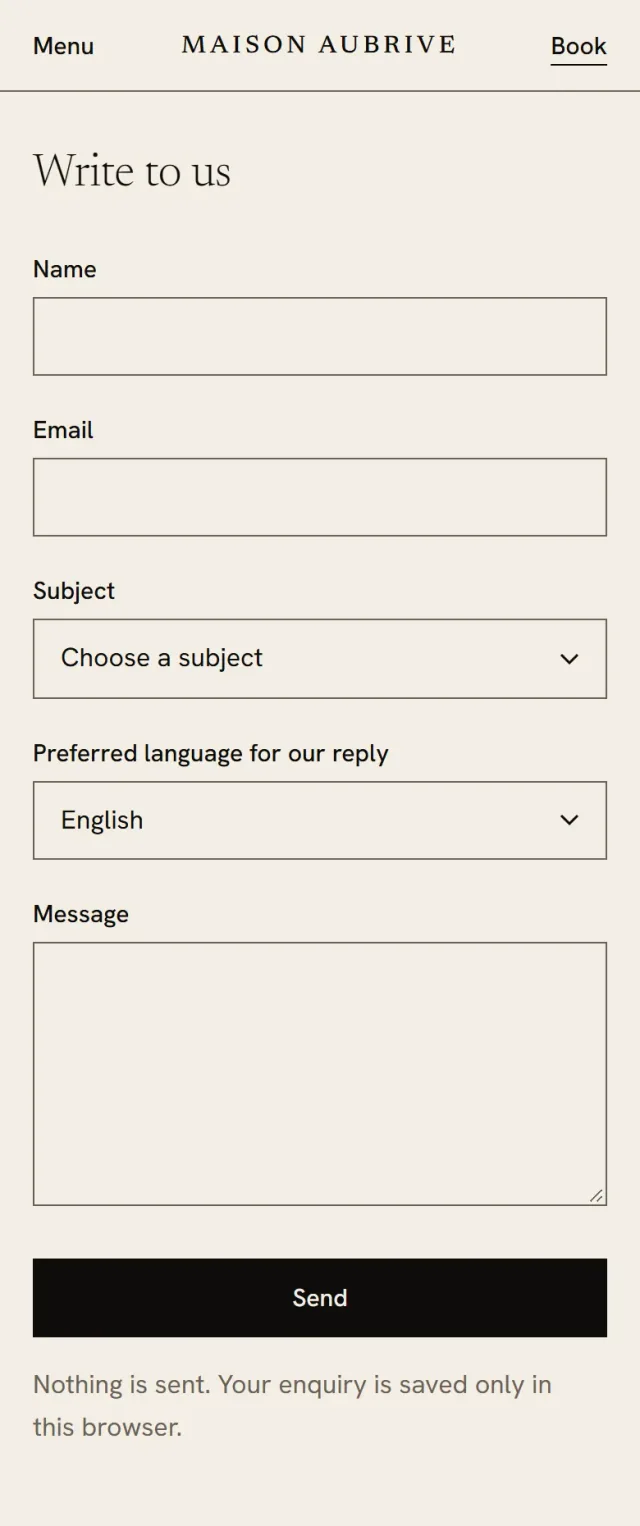
Contact, and an enquiry form
For visitors who aren’t ready to design a ring: the boutique’s address, telephone, opening hours and directions, and a form that asks which language the reply should be in. As with bookings, nothing is sent in this concept, and the form says so.
Build quality
Checked with Google’s Lighthouse test, 35 automated tests and three rounds of screenshot review.
Google’s Lighthouse test
On a phone setting, on the home page: 100 out of 100 for speed, for accessibility (whether disabled people can use it) and for good practice. The main picture appears in 0.8 seconds, and nothing jumps about as the page loads.
Search score 66, on purpose
Every check passes except one: the site tells search engines not to list it, on purpose, because it’s a concept.
35 automated tests passed, 0 failed
At phone and desktop widths. They cover the whole journey from design to confirmation, prices in every language and appointment times for visitors in Paris and Tokyo. Three more are skipped on purpose: they check parts that only exist at one width.
No errors, no tracking
Every page in all seven languages was opened at both widths: no errors, and no requests to anyone else’s servers.
Faults found and fixed
Three rounds of screenshot review fixed every layout fault found. Three later faults were fixed, with five new tests to stop them coming back.
Not yet done
Testing in Safari, Firefox or on a real phone (only Chrome so far), and checking the translations with native speakers.
Could this help your business?
Do customers buy from you in person?
Then your website’s job is to bring them in ready. Here the jeweller knows the metal, shape, size, setting and rough budget before the door opens, so the hour is spent on the stone, not on questions. It works for a tailor, a kitchen designer, a bridal shop or a furniture maker.
Customers in other countries?
Visitors check the price range before they book, so budgets are clear on both sides. And booking needs no email and no waiting: someone in Tokyo can do all of it in Japanese, at midnight their time.
What would a site like this cost?
About 5 to 6 weeks and €16,250 to €19,500. A real project like this includes your own words, pictures and video, rounds of changes, translations checked by native speakers, a link to your real diary and email, a page for managing bookings, and testing on real phones and browsers. The price depends on how much of that you need.
Want customers to book before they visit?
Tell me what you need, and I’ll tell you honestly what it would take.